One day in Santiago, Chile will not show you the whole city, but it is enough to get a good first impression of the Chilean capital. With a well-planned route, you can walk through the historic center, visit one or two viewpoints, explore neighborhoods with local life, and better understand the contrast between old Santiago and the modern city that stretches toward the Andes.
The main rule is simple: do not try to cover too much. Santiago is a big city, and some areas are farther apart than they look on a map. If you only have one day, choose a clear route and avoid unnecessary backtracking.
In this article, we focus on planning a route through the historic center of Santiago in a single day. It is also useful if you are considering a private Santiago full-day tour or a private Santiago half-day tour focused on the historic center and nearby highlights.
What to See in Santiago, Chile in One Day: Historic Center, Neighborhoods and Classic Viewpoints
What to See in Santiago, Chile in One Day
Santiago, Chile
What to see in Santiago, Chile in one day
Start with the Historic Center of Santiago
The historic center is the best place to start your visit to Santiago. Some of the city’s most important buildings are here, and this is where it is easiest to understand Chile's political, religious, and urban history.
Begin your day at La Moneda Palace, the seat of the Chilean government and one of the country’s most symbolic buildings. It was originally built as a mint during the colonial period and later became the political heart of Chile. If the timing works, you may be able to see the changing of the guard in front of the palace. The ceremony takes place on specific days, so it is worth checking the schedule in advance.
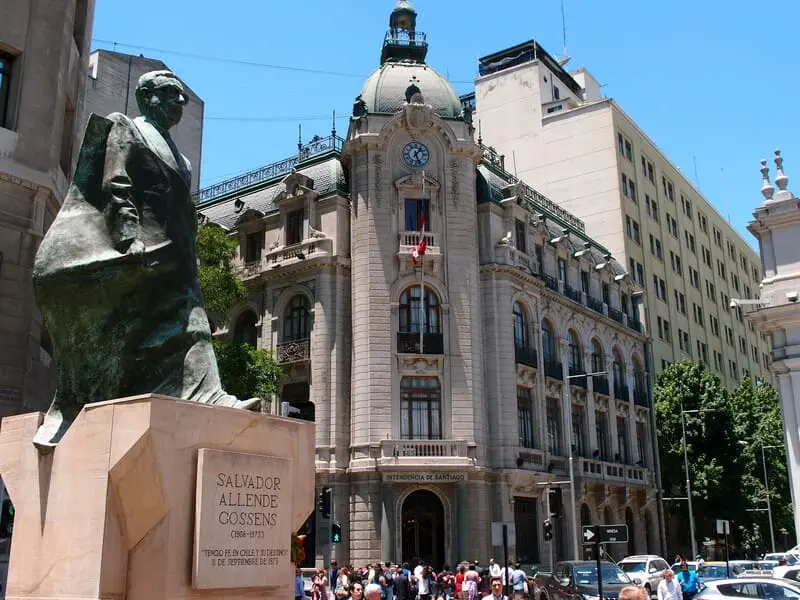
From La Moneda, walk toward Constitution Square and then continue to Plaza de Armas, the historic core of Santiago since the city’s foundation in the 16th century. The square is surrounded by some of the most representative buildings in the center: the Metropolitan Cathedral, the old Central Post Office and the National History Museum, located in the former Royal Court Palace.
For a first Santiago city tour, this area is essential. Plaza de Armas is not just a monumental square. It is also a very active public space, with office workers, street musicians, families, tourists, vendors, and people simply sitting and watching the movement of downtown Santiago.
Continue the route with the Church of San Francisco, one of the oldest churches in Santiago and a key stop in the historic center. At first glance, it may look simple, especially when compared with the scale of the Metropolitan Cathedral, but that is part of its appeal. San Francisco preserves a colonial atmosphere that feels different from the rest of the center.
Next to the church is the San Francisco Colonial Art Museum, housed in the former rooms of the Franciscan convent. It is a worthwhile stop if you are interested in religious art, colonial history, or a less obvious side of Santiago. Its rooms include vice-regal painting, religious sculpture, liturgical textiles and objects connected with the presence of the Franciscan Order in Chile.
One of the museum’s most important treasures is a series of paintings dedicated to the life of Saint Francis of Assisi, created in the artistic world of Cuzco and sent to the Franciscan convent in Santiago during the colonial period. Beyond their religious value, these works help show how images, workshops and ideas circulated between Peru, Chile and other territories of the vice-regal world.
If you walk this route on your own, you can see the main buildings in one morning. With a local guide, the walk becomes much clearer: façades, squares and churches start to tell a wider story about Santiago’s foundation, colonial life, political change and the way the city center has evolved over time.
Go Up Santa Lucía Hill
After walking through the historic center, Santa Lucía Hill is a natural next stop on a Santiago full-day city tour. It is not just a viewpoint. It is one of the city’s classic urban parks, located right in the center, very close to Lastarria and Alameda.
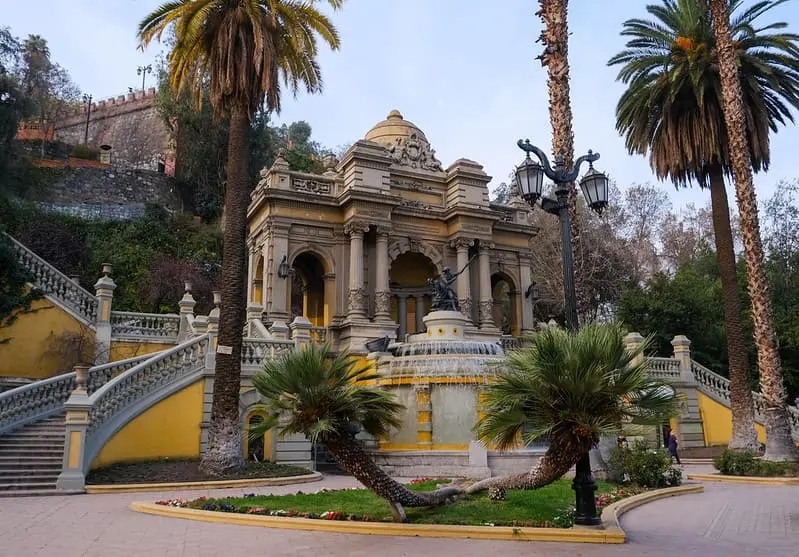
The hill was transformed into a public promenade in the 19th century under Benjamín Vicuña Mackenna, and it still keeps some of the atmosphere of an old city walk. Along the way, you will find stone staircases, terraces, gardens, fountains, and small lookout points. One of the most photogenic spots is the Neptune Terrace, with its monumental fountain and symmetrical stairs. Higher up, there is a viewpoint with views over central Santiago.
The climb is short, although the last section can feel a little steep, especially on hot days. From the viewpoints, it becomes easier to understand how Santiago spreads out between the Andes and the Coastal Range. On clear days, especially after rain or in winter, the mountains are much easier to see.
If Santa Lucía Hill is included in a private Santiago tour, 30 to 60 minutes is usually enough, depending on the group's pace and the number of photo stops. Keep in mind that Cerro Santa Lucía works as an urban park: it has opening hours and may close on rainy days. If you visit on your own, check the current schedule before going.
Walk Through Lastarria
At the foot of Santa Lucía Hill is Lastarria, one of the most pleasant neighborhoods for a short walk in Santiago. It is a small area with cafés, restaurants, bookstores, galleries, old buildings, and a visible cultural life.
This is a good place to pause for coffee, have a light lunch, or simply walk without rushing. On some days, you may find small stalls selling books, antiques or design objects, and the atmosphere is especially enjoyable in the afternoon.
Lastarria is also close to the National Museum of Fine Arts and the Museum of Contemporary Art, so it is easy to add a cultural stop here if the weather is not ideal for a long walk or if you want to balance the day with something quieter.
On a private Santiago half-day tour, Lastarria often works well as a final stop if the route focuses on the historic center, Santa Lucía and the nearby areas. On a private Santiago full-day tour, it can serve as a natural pause before continuing toward Bellavista, San Cristóbal Hill, or the modern districts of Providencia and Las Condes.
Choose One Museum, Not All of Them
Santiago has several interesting museums, but if you only have one day in the city, it is better to choose one, or at most two. Trying to visit too many museums in a single day can make the route feel heavy and take time away from walking, neighborhoods, and the city itself.
One of the best museums for a first visit is the Chilean Museum of Pre-Columbian Art, located near Plaza de Armas. Its collection includes objects, textiles, ceramics, and pieces from different Indigenous cultures across the Americas. It is a good option if you want to go beyond colonial history and better understand the continent’s cultural depth.
Another important stop is the Museum of Memory and Human Rights. It is dedicated to the human rights violations that took place during the military dictatorship in Chile. It is not a light visit, but it is one of the most important places for anyone who wants to understand a key part of the country’s recent history.
If you prefer art and architecture, you can choose the National Museum of Fine Arts or the Museum of Contemporary Art, both located near Lastarria and Parque Forestal. Another option is La Chascona, one of Pablo Neruda’s houses, located in Bellavista. In that case, it is better to check opening hours and availability in advance, as it does not always fit easily into a spontaneous one-day route.
Practical tip: for a one-day route, choose the museum according to your main interest. If you are interested in ancient American history, go to the Pre-Columbian Art Museum. If you are interested in Chile’s recent history, choose the Museum of Memory. If you prefer art, stay around Bellas Artes and Lastarria.
Cross Over to Bellavista
From Lastarria and Bellas Artes, you can continue toward Bellavista by crossing the Mapocho River. Bellavista is one of Santiago’s best-known neighborhoods, known for its bohemian atmosphere, murals, restaurants, bars, shops, and nightlife. During the day, it shows the city's more informal side.
This is also one of the access points to San Cristóbal Hill and the Metropolitan Park, so it fits well into an afternoon route: first a short walk through the neighborhood, then the climb up the hill for one of Santiago’s most famous views.
La Chascona, Pablo Neruda’s house museum, is also located in Bellavista. If you know Neruda’s work or enjoy house museums with character, it can be a good stop. If not, it may be better to leave it for a second day and avoid overloading the route.
For travelers looking for a private Santiago city tour that combines history, neighborhoods and viewpoints, Bellavista offers another side of the city: less formal than the center, more colorful, more relaxed and closely connected to Santiago’s cultural life.
Go Up San Cristóbal Hill
San Cristóbal Hill is one of Santiago’s classic stops. It is part of the Metropolitan Park, the city’s main urban park, and offers some of the widest views over the capital.
There are several ways to go up. The classic option is from Bellavista, via the Pío Nono entrance, and takes the historic funicular to the upper part of San Cristóbal Hill. Another option is to enter through Pedro de Valdivia and take the Santiago Cable Car from Oasis station.
If the schedule and operation of the day allow it, it is a good idea to combine both systems: go up one side and come down the other. For example, you can go up by funicular from Bellavista and descend by cable car toward Pedro de Valdivia, or do the route in the opposite direction. This way, the ride itself becomes part of the experience, and you see different areas of the Metropolitan Park along the way.
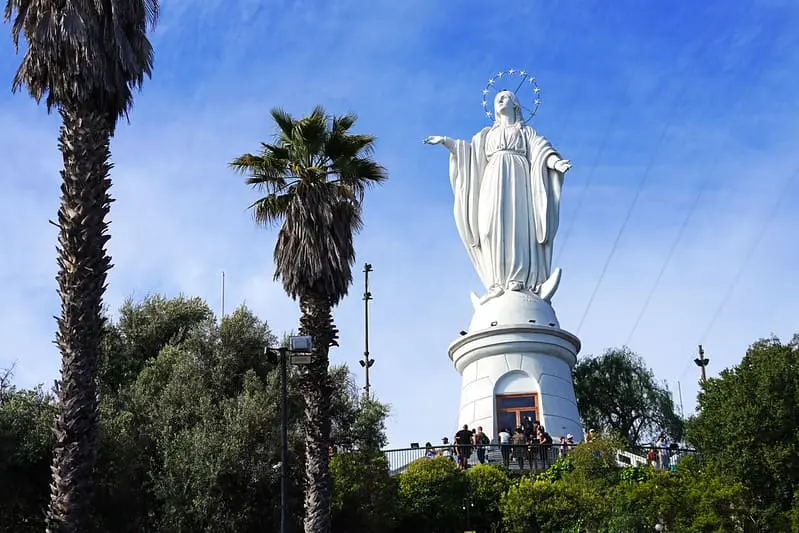
At the top, you will find the Sanctuary of the Immaculate Conception and a large statue of the Virgin Mary. From there, you can see Santiago spread out below, and on a clear day the Andes appear as the city’s backdrop. Keep in mind that Santiago is a large metropolis, and there are often days with air pollution or limited visibility, so the mountains are not always sharply visible.
Practical tip: do not build your entire day around one view. The funicular and cable car can change schedules, close for maintenance, or be affected by weather and visitor numbers. If you only have one day in Santiago, it is better to keep some flexibility.
On a Santiago full-day city tour, San Cristóbal is usually one of the most valuable stops because it lets you see the city from above: the historic center, residential neighborhoods, the eastern districts, modern buildings and the Andes. It can also be included in a half-day tour, but that depends on timing, traffic, and whether the funicular or cable car is operating normally.
Is Sky Costanera Worth It?
Sky Costanera is another well-known viewpoint in Santiago. It is located in the tallest tower of the Costanera Center complex, in Providencia, and offers a 360-degree view over the city. It can be a good option if you enjoy urban views or want to see Santiago from a much higher vantage point, especially close to sunset.
But if you have already gone up San Cristóbal Hill and your time is limited, Sky Costanera is not essential. The hill offers a more natural, park-like experience, while Sky Costanera offers views of the city from a modern tower. They are different views. If you have time, energy and a clear day, you can include both. If not, choose one according to your travel style.
For a first visit, especially if you are looking for what to do in Santiago in one day, it is better to prioritize a balanced route: the historic center, Santa Lucía, Lastarria, Bellavista and San Cristóbal. If you still have time afterward, or if you want to see the more modern side of Santiago, Providencia, Las Condes and Sky Costanera can be left for the second part of the day or for a separate route.
In the next article, we will look at the eastern side of Santiago in more detail, so you can build a fuller guide for a complete Santiago full-day tour.